D-8 Visa Application Guide for Korea: D-7 Differences and F-3 Dependent Visa
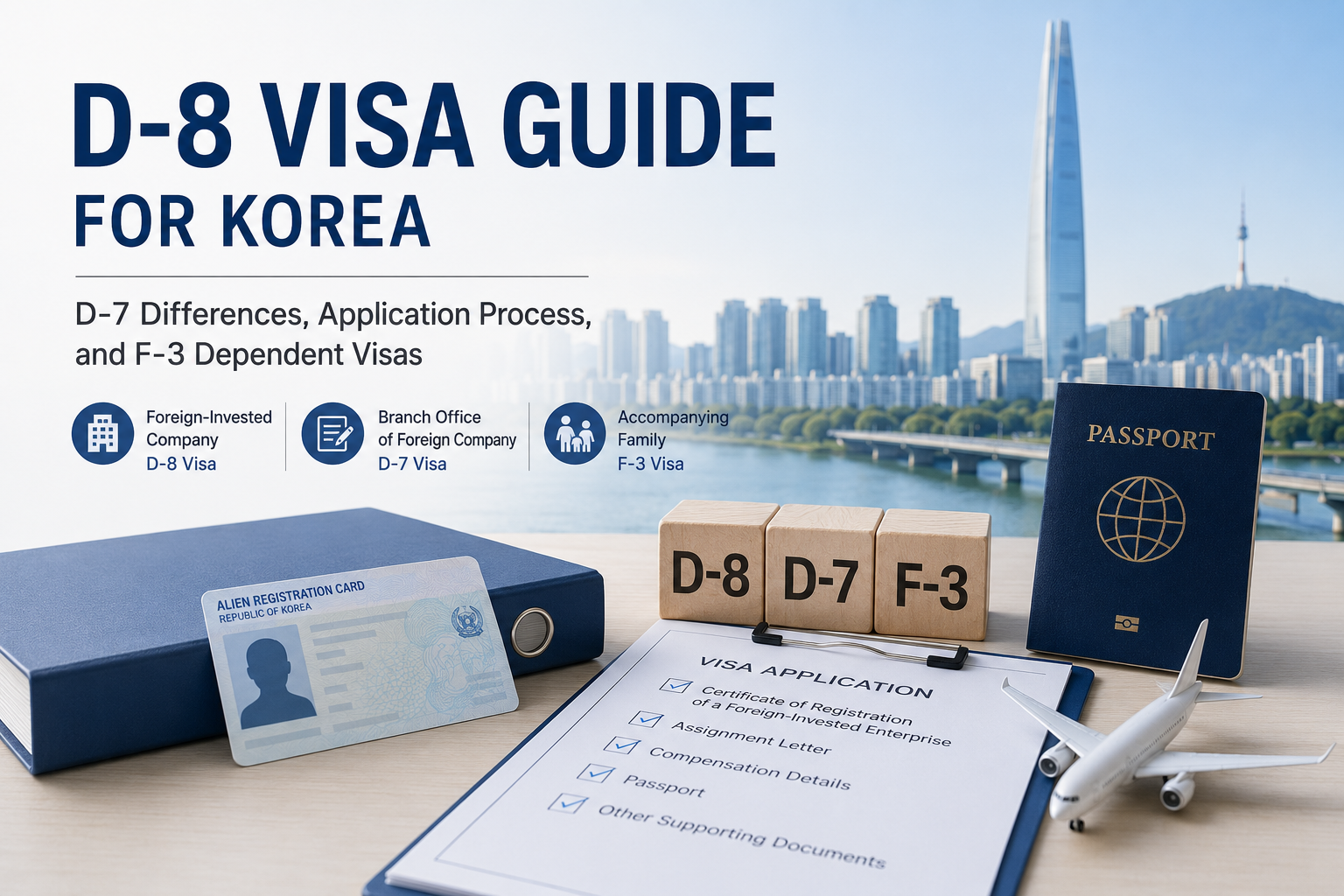
When a foreign executive or employee is assigned from an overseas headquarters to an affiliated company in Korea, one of the first questions the company must address is:
Which visa category should the assignee apply for?
In practice, the D-8 and D-7 visa categories are sometimes confused because both may apply to employees transferred from an overseas company to an operation in Korea.
However, the correct visa category depends primarily on the legal structure and registration status of the Korean entity.
This article explains the difference between D-8 and D-7 visas, the two main D-8 application procedures, and important considerations for accompanying family members applying for F-3 dependent visas.
D-8 or D-7: Which Visa Is Appropriate?
The most important distinction between the D-8 and D-7 visa categories is the legal status of the entity in Korea.
D-8 Visa for a Foreign-Invested Company
A D-8 visa is generally appropriate when the employee is assigned to a Korean company that is registered as a foreign-invested company.
A registered foreign-invested company should normally hold a:
Certificate of Registration of a Foreign-Invested Enterprise
This certificate is a key supporting document for a D-8 visa application and must be included in the application package.
D-7 Visa for a Korean Branch of a Foreign Company
A D-7 visa is generally appropriate when the Korean operation is established as a branch office or liaison office of a foreign company.
In this case, the Korean operation will normally hold documentation such as:
- A permit for the establishment of a domestic branch of a foreign company
Before beginning the visa application process, the company should first confirm whether the Korean entity is:
- A foreign-invested Korean corporation, or
- A Korean branch or liaison office of an overseas company
This determination directly affects whether the D-8 or D-7 category should be used.
Key Documents for a D-8 Visa Application
For a D-8 visa application, one of the most important documents from the Korean host company is the:
Certificate of Registration of Foreign-Invested Enterprise
Without this document, it may be difficult to establish that the Korean company qualifies as a foreign-invested company for D-8 purposes.
One of the most important documents to be prepared by the overseas headquarters is the:
Assignment Letter
This assignment letter should clearly explain the employee's transfer to Korea, including the assignment period, job title, duties, employing entity, host entity, and compensation arrangements.
Compensation Information is Important for F-3 Dependent Visa
When the assignee is relocating to Korea with a spouse or children, the family members will generally apply for F-3 dependent visa.
In such cases, the assignment letter should clearly state the assignee's full salary information.
This should include:
- Salary paid in Korea
- Salary continuing to be paid by the overseas headquarters
Immigration authorities may review the principal applicant's financial ability to support accompanying family members in Korea.
For this reason, providing only the portion of the salary paid in Korea may not fully reflect the employee's actual financial circumstances.
Including the entire compensation package can help present the application more clearly and consistently.
Two Main Ways to Apply for a D-8 Visa
There are generally two possible application routes for a D-8 visa.
Option 1: Applying for a Confirmation of Visa Issuance
The first and most commonly used method is to apply for a Confirmation of Visa Issuance while the foreign employee is still outside Korea.
The application is submitted in Korea by:
- The Korean host company or
- An authorized immigration and administrative service provider, such as Team KF
The application is filed with the immigration office having jurisdiction over the Korean host company's registered address.
Once the application has been reviewed and approved, a Confirmation of Visa Issuance Number is issued.
The employee then uses this number to apply for the actual D-8 visa at the Korean embassy or consulates in their country of residence.
Typical Processing Time in Korea
The immigration review usually takes approximately:
- Around three weeks under normal circumstances
- Four to five weeks during busy periods or when additional review is required
Processing times are estimates and may vary depending on the immigration office, application volume, and the specific circumstances of the case.
Visa Application at the Korean Embassy or Consulate
After receiving the Confirmation of Visa Issuance Number, the employee submits the visa application to the relevant Korean diplomatic mission abroad.
The processing time at the embassy or consulate may vary, but it commonly takes:
- Approximately three to five business days in straightforward cases
- Up to two weeks or longer in some locations
The employee may enter Korea once the visa has been issued.
Residence Card Application After Arrival in Korea
After entering Korea with the D-8 visa, the employee must apply for residence card with the immigration office having jurisdiction over their residential address.
Some immigration offices in Korea like the one in Seoul operates counters for D-8 applicants. In those counters, residence card application by D-8 visa holder would be accepted without the standard online appointment.
Option 2: Entering Korea First and Applying for a Change of Status
The second option is for the foreign employee to enter Korea first under a visa-waiver and then apply to change their status of stay to D-8 within Korea.
Under this procedure, the employee generally submits applications for:
- Change of status to D-8
- Residence card
at the same time.
The employee may visit the designated D-8 counter at the relevant immigration.
Typical Processing Time
The review of the change of status application may take approximately three weeks.
The physical residence card may be issued approximately four weeks after the application, although actual processing times may vary.
Why This Route May Not Be Suitable for Families
The change of status route may be practical when the employee enters Korea alone.
However, it is generally not the preferred option when the employee plans to enter Korea together with a spouse and children.
Dependent family members entering Korea under a visa-waiver cannot automatically change to F-3 status simply because the principal applicant applies for D-8 status.
In-country changes to F-3 status may only be permitted in limited circumstances where immigration office recognizes a sufficiently compelling or unavoidable reason.
The interpretation of such circumstances may depend on:
- The individual facts of the case
- The supporting documents submitted
- The judgment of the reviewing immigration officer
As a result, there is meaningful risk that the family members may not be permitted to change their status within Korea.
For families planning to relocate together, it is generally safer to apply for the D-8 and F-3 visas before entering Korea.
What Happens If the Employee Enters Korea First?
In some cases, the employee may need to enter Korea before the accompanying family members.
The employee may enter Korea, complete the D-8 change of status process, and obtain a residence card. Once the employee's residence card has been issued, a copy can be sent to the family members abroad.
The accompanying spouse and children can then apply for F-3 visas at the Korean embassy or consulate in their country of residence.
The general process is as follows:
- The employee enters Korea.
- The employee applies for a change of status to D-8 and residence card.
- The residence card is issued.
- A copy of the card is sent to the family members abroad.
- The family members apply for F-3 visas with required documents including the copy of the card at the relevant Korean embassy or consulate.
- After the F-3 visas are issued, the family members enter Korea.
- The family members apply for residence cards after arrival.
This route is possible, but it may delay the family's relocation because the F-3 application generally begins only after the principal applicant's residence card has been issued.
Which Application Route is Better?
The most appropriate route depends on the employee's situation.
The confirmation of Visa Issuance Route Is Usually Better When:
- The employee is still overseas
- The employee will relocate together with a spouse or children
- The company wants greater certainty before the employee travels to Korea
- The assignment start date allows sufficient time for advance processing
The Change of Status Route May Be Considered When:
- The employee needs to enter Korea urgently
- The employee is relocating alone
- The employee is legally eligible to enter Korea without obtaining a D-8 visa in advance
- The Korean host company has already prepared all required supporting documents
The timing, nationality, family composition, and business circumstances should all be reviewed before selecting an application route.
Careful Preparation Can Prevent Delays
A D-8 visa application involves more than simply submitting a standard list of documents.
Companies should carefully review:
- Whether the Korean entity qualifies for D-8 status
- Whether D-7 may instead be the correct category
- The contents of the assignment letter
- The assignee's full compensation information
- Whether accompanying family members will apply for F-3 visas
- Whether the application should be filed through confirmation of visa issuance or through in-country change of status
- The expected immigration and consular processing timeline
A missing document or an incorrectly selected application route can affect the employee's assignment start date and the family's relocation schedule.
Professional Support for D-8, D-7, and F-3 Visa Application
Team KF supports multinational companies, foreign-invested enterprises, and international assignees throughout the Korean immigration and relocation process.
Our services include:
- D-8 and D-7 visa assessment
- Confirmation of Visa Issuance applications
- Change of status applications
- F-3 dependent visa support
- Assignment letter and document review
- Residence Card applications
- Housing and settling-in services
Because each assignment has different corporate, immigration, and family circumstances, we recommend reviewing the full case before beginning the application.
Professional guidance at the initial stage can help the company select the correct visa category, prepare the necessary documents, and avoid unnecessary delays throughout the relocation process.