How Foreign Employees Can Get a Debit Card and Credit Card in Korea | Complete Banking Guide
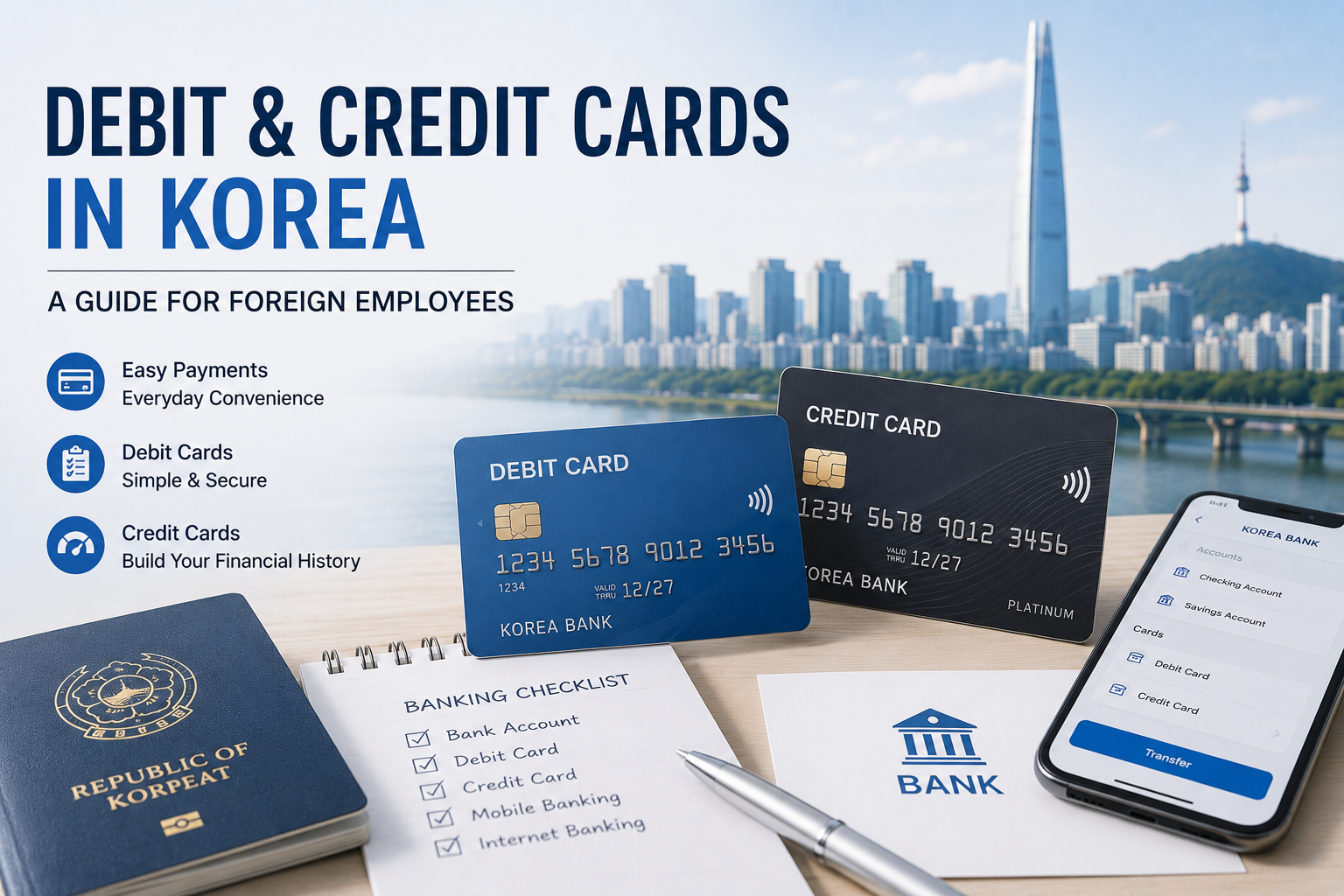
Debit Cards and Credit Cards in Korea: A Guide for Foreign Employees
How Foreign Residents Can Apply for Banking Cards After Opening a Korean Bank Account
After opening a bank account in Korea, one of the next questions many foreign employees ask is:
"Can I apply for a debit card or a credit card right away?"
Since Korea is a highly cashless society, debit and credit cards are used almost everywhere—from convenience stores and restaurants to online shopping, and everyday purchases.
Having the right banking card makes daily life significantly easier for expatriates living and working in Korea.
In this guide, we explain how foreign employees can obtain debit and credit cards in Korea, what requirements typically apply, and what to expect based on our practical relocation experience.
Opening a Korean Bank Account Comes First
Before applying for either a debit card or a credit card, you must first open a Korean bank account.
In our previous guide, we explained the documents generally required to open a bank account in Korea, including:
- Alien Registration Card (ARC)
- Passport
- Certificate of Employment
- Tax Identification Number (TIN) from your home country
Once the bank account has been successfully opened, you may apply for banking cards offered by the bank.
Debit Cards Are Usually Easy to Obtain
For most foreign employees, obtaining a debit card is relatively straightforward.
A debit card is directly linked to your Korean bank account, meaning purchases are deducted immediately from the available account balance.
Because there is no borrowing involved, banks generally have fewer approval requirements compared with credit cards.
Many Korean banks can issue a debit card on the same day that the bank account is opened.
Depending on the bank, applicants may also request additional features such as:
- International payment capability
- Transportation card function (T-money)
- Contactless payment
Some banks also offer postpaid transportation functions, although eligibility may depend on the bank's internal review.
Credit Cards Require a Separate Approval Process
Credit cards are different.
Unlike debit cards, credit cards are not issued automatically after opening a bank account.
Instead, the issuing card company evaluates each applicant individually. Normally there are separate entities for credit cards from each bank in Korea. For example, Hana Bank co-work with Hana Card. And Hana Card is the entity which will review and approve the credit card.
Typical review factors may include:
- Employment status in Korea
- Monthly income
- Korean credit history
Foreign employees are certainly eligible to apply for Korean credit cards.
However, approval is not guaranteed simply because a bank account has been opened.
Each bank and card issuer applies its own underwriting policies and approval criteria.
Newly Arrived Foreign Employees May Have Difficulty Obtaining a Credit Card
Many expatriates apply for a credit card shortly after arriving in Korea.
In some cases, the application may be declined—not because the applicant is a foreign national, but because there is very little financial history available in Korea.
When someone has only recently arrived, they generally have:
- No Korean credit record
- Limited banking history such as monthly salary
- No previous repayment history
As a result, the card issuer may not have sufficient information to assess creditworthiness.
After few or several months of employment, regular salary deposits, and normal banking activity, many foreign employees establish a stronger financial profile and may have a better chance of being approved for a credit card.
Banks and Card Companies Are Separate Businesses
One point that often surprises expatriates is that banks and credit card companies operate as separate entities.
For example, opening an account at Shinhan Bank does not automatically mean that Shinhan Card will issue a credit card.
The bank is responsible for maintaining the customer's deposit account.
The card company independently reviews the application and decides whether to approve or decline the credit card request.
This distinction is important because it explains why a customer may successfully open a bank account while still receiving a different outcome for a credit card application.
A Debit Card Is Sufficient for Most Daily Life in Korea
Some foreign employees worry when they are unable to obtain a credit card immediately.
Fortunately, a debit card is accepted almost everywhere in Korea.
In everyday life, debit cards can be used for:
- Restaurants and cafés
- Convenience stores
- Supermarkets
- Online shopping
- Taxi services
- Entertainment and retail stores
For many expatriates, a debit card provides all the functionality needed during the first months of living in Korea.
Later, after establishing a financial history, they may choose to apply for a credit card.
Banking Services Worth Setting Up During Your Visit
When visiting the bank, we usually recommend completing several banking services at the same time.
These include:
- Debit card issuance
- Internet banking
- Mobile banking
- One-Time Password (OTP) device or digital authentication
- Salary account registration
- Overseas transaction activation (if required)
Setting up these services during the initial visit can save additional trips to the bank and make everyday banking much more convenient.
Practical Tips for Foreign Employees
Based on our relocation experience, here are a few practical recommendations:
- Bring all required documents, even if the bank mentions only a few.
- Visit a branch that frequently assists international customers whenever possible.
- Ask whether English-language mobile banking support is available.
- If a credit card application is declined, consider reapplying after establishing fewl months of banking and salary history.
- Keep your Residence Card valid, as many banking services depend on your immigration status.
How Team KF Supports International Assignees
For foreign employees, banking is often one of the first administrative tasks after arriving in Korea.
Although opening a bank account and obtaining a debit card are generally straightforward, language barriers and differing procedures between banks can sometimes make the experience more challenging than expected.
At Team KF Relocation Services, we regularly accompany expatriates to Korean banks and assist with:
- Bank account opening
- Debit card applications
- Mobile and internet banking registration
- Communication with bank staff
- General banking guidance for newly arrived employees
By helping clients understand the banking process before visiting the branch, we aim to make one of the most important settling-in tasks simple and stress-free.
Final Thoughts
Debit cards are generally easy for foreign employees to obtain after opening a Korean bank account and are sufficient for most day-to-day transactions.
Credit cards, however, involve an independent review process and approval depends on factors such as employment, income, immigration status, and financial history in Korea.
Understanding these differences before visiting the bank can help set realistic expectations and make the banking process much smoother.
At Team KF, we support multinational companies and international assignees throughout every stage of relocation—from visas and immigration procedures to banking, housing, and settling-in services.