How to Open a Bank Account in Korea for Foreign Employees | Required Documents and Practical Guide
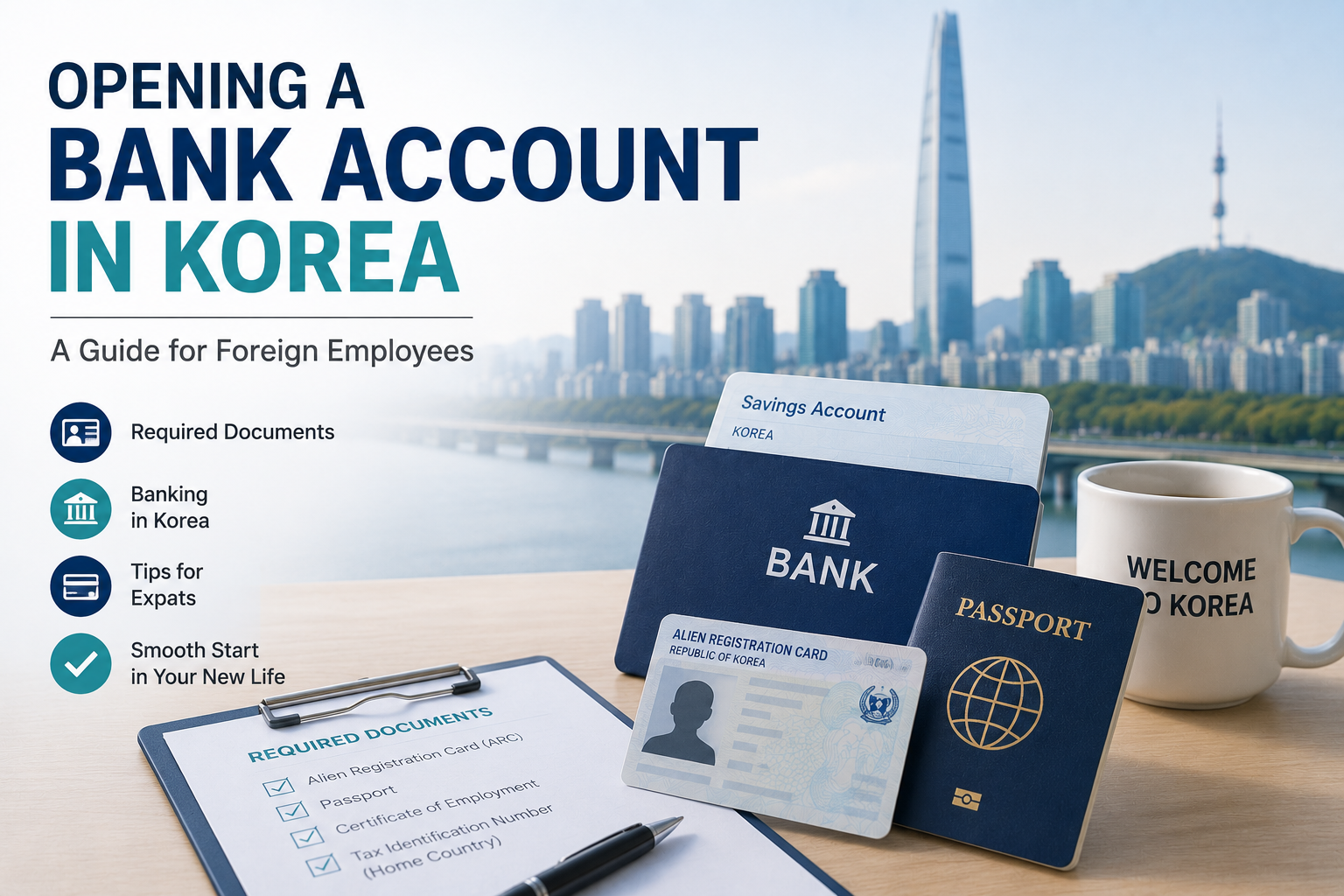
Opening a Bank Account in Korea: A Guide for Foreign Employees
Required Documents, Alien Registration Card, and Tax Identification Number
Opening a bank account is one of the first administrative tasks foreign employees need to complete after relocating to Korea.
A Korean bank account is essential not only for receiving salary payments, but also for many aspects of daily life, including:
- Receiving payroll
- Paying utility bills
- Setting up automatic payments
- Applying for debit or credit cards
- Using mobile banking services
- Managing everyday expenses
The good news is that opening a bank account in Korea is generally straightforward, provided the required documents are prepared in advance.
In this guide, we explain the basic requirements, common questions, and practical considerations based on our experience supporting expatriates relocating to Korea.
Documents Required to Open a Bank Account in Korea
Although document requirements may vary slightly depending on the bank, foreign employees are generally asked to provide:
- Alien Registration Card (ARC)
- Passport
- Certificate of Employment issued by the Korean employer
- Tax Identification Number (TIN) from their home country
Some banks may request additional documents depending on the individual circumstances, but these are the core documents most applicants should prepare.
The Alien Registration Card Is the Most Important Document
One of the most common questions we receive is:
"Can I open a bank account immediately after arriving in Korea?"
In most cases, the answer is not immediately.
The main reason is that foreign residents usually need to obtain an Alien Registration Card (Residence Card) before opening a standard bank account.
After arriving in Korea, eligible foreign nationals must apply for residence card through the local immigration office.
The Residence Card is typically issued few weeks after the application is submitted.
As a result, many newly arrived employees cannot open a regular bank account on their first day in Korea.
Can a Bank Account Be Opened with Only a Passport?
Sometimes—but it depends.
In certain cases, some bank branches may allow a foreign employee to open a bank account using only a passport if the employee has already applied for a Residence Card.
Several years ago, this practice was relatively common.
However, due to increased efforts to prevent financial fraud, identity theft, and misuse of bank accounts, Korean banks have significantly strengthened their internal compliance procedures.
Today, opening a bank account with only a passport has become much less common.
While exceptions may still exist, applicants should not assume this option will be available.
Why Is My Home Country's Tax Identification Number Required?
Another question we frequently hear is:
"Why does a Korean bank need my Tax Identification Number from my home country?"
The answer lies in international tax reporting obligations.
Like financial institutions in many other countries, Korean banks may collect customers' Tax Identification Numbers (TINs) to comply with international tax information reporting standards.
This helps financial institutions identify the customer's country of tax residence where required by applicable regulations.
Fortunately, applicants usually do not need to submit official proof of their Tax Identification Number.
In most cases, simply knowing and providing the correct number is sufficient.
The name of the identifier differs by country.
For example:
- United States – Tax Identification Number (TIN) or Social Security Number (SSN)
- Germany – Tax Identification Number (Steueridentifikationsnummer)
- United Kingdom – National Insurance Number (where applicable)
- Other countries – National tax identification number or equivalent
Applicants should check the appropriate identifier used in their own country before visiting the bank.
Bank Procedures May Differ Between Branches
One important point many expatriates do not realize is that banking procedures are not always identical across every branch.
Even within the same bank, individual branches may have slightly different operational practices regarding:
- Opening an account before the Alien Registration Card is issued
- Additional supporting documents
- Immediate issuance of debit cards
- Internet banking registration
- Mobile banking activation
For this reason, confirming the requirements with the specific branch before visiting can often save time.
Branches that frequently assist foreign customers are generally more familiar with international documentation and relocation-related banking needs.
Services Worth Setting Up at the Same Time
After opening a bank account, we generally recommend applying for additional banking services during the same visit.
These may include:
- Debit card issuance
- Internet banking
- Mobile banking
- One-Time Password (OTP) device
- Salary account registration
Mobile banking has become an essential part of everyday life in Korea, making it worthwhile to complete the setup before leaving the branch.
How Team KF Supports International Assignees
Opening a bank account is often one of the first practical steps toward settling into life in Korea.
Although the process itself is usually straightforward, language barriers, documentation requirements, and differences between bank branches can sometimes make the experience more challenging than expected.
At Team KF Relocation Services, we regularly accompany expatriates to Korean banks and assist them throughout the account opening process.
Our support includes:
- Preparing the required documents before the bank visit
- Explaining banking procedures in English
- Assisting communication with bank staff
- Helping set up internet and mobile banking
- Providing practical advice based on real relocation experience
Our goal is to help international assignees complete essential administrative procedures efficiently so they can focus on beginning their new life and career in Korea.
Final Thoughts
Opening a Korean bank account is an important milestone for every foreign employee relocating to Korea.
With the proper documents—and a clear understanding of the process—the procedure is generally smooth.
However, requirements may vary slightly between banks and even between individual branches.
Preparing in advance and seeking professional guidance when needed can help avoid unnecessary delays and make the relocation process significantly easier.
At Team KF, we are committed to helping international employees and multinational companies navigate every stage of relocation, from visa applications and banking to housing and settling-in services.